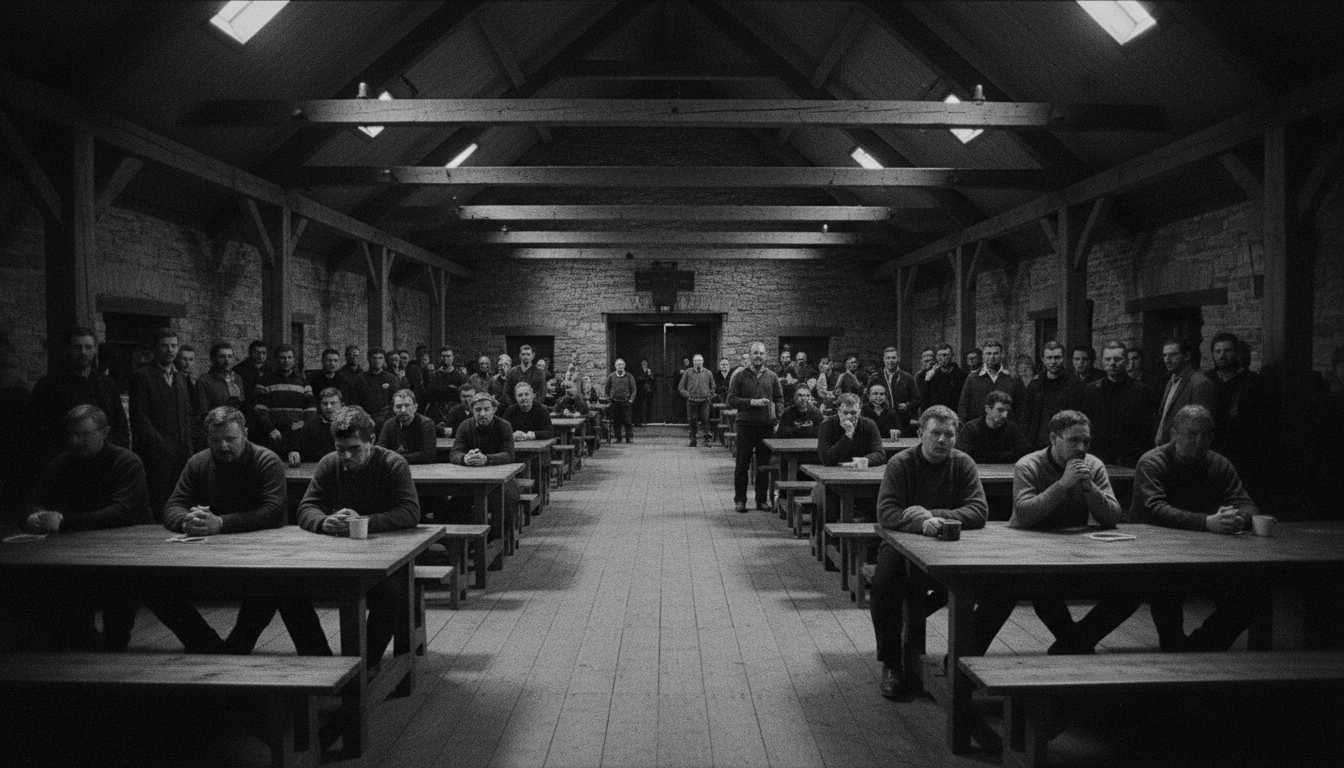
Two hundred men. One mountain lodge. Three days. No phones. No pitches. No business cards. Just men who decided that friendship was worth the airplane ticket, the vacation days, and the discomfort of showing up somewhere where nobody knows your title and nobody cares about your revenue.
The Pareon Quarterly Gathering — we call it the Muster — isn't a conference in any traditional sense. There are no keynote speakers droning through slide decks. No breakout sessions with name tags and icebreaker games. No vendor booths or swag bags. What there is, is a carefully architected three-day experience designed to do one thing: accelerate the transition from strangers to brothers.
"NOT A CONFERENCE. A RITE OF PASSAGE."
DAY ONE: ARRIVAL
The first thing you notice is the silence. The lodge is deliberately remote — far enough from civilization that cell service is unreliable and your inbox becomes someone else's problem. You check in, you're assigned a cabin with three other men, and you eat dinner together. No facilitation. No structure. Just a meal, a fire, and the ambient nervousness of 200 men who are all thinking the same thing: "What am I doing here?"
That nervousness is the point. The Muster is designed to replicate the conditions under which men have bonded for millennia — shared discomfort, shared purpose, and the absence of escape routes. You can't check your phone. You can't retreat to your hotel room and order room service. You're here. They're here. Now what?
DAY TWO: THE FORGE
Day two is where it happens. The morning starts with a physical challenge — not a competition, but a shared struggle. A long hike. A cold water plunge. Something that makes your body do something hard alongside other men. Evolutionary psychology tells us that shared physical challenge accelerates trust. It's why firefighters are so tight. It's why soldiers form bonds that outlast decades. Your body doesn't lie, and when it's working hard next to someone else's body, the walls come down faster.
THE MUSTER SCHEDULE
The afternoon is structured around what we call "The Circle." Groups of eight men, a trained facilitator, and a single question. The questions aren't clever. They're direct. "What are you most afraid of right now?" "When was the last time you cried, and why?" "If you could tell your father one thing, what would it be?"
These questions break men. Not in a destructive way — in a necessary way. Like setting a bone that healed wrong. The facilitator's job isn't therapy. It's permission. Permission to say the thing that's been sitting in your chest for years, in a room full of men who aren't going to judge you, fix you, or tell you to man up.
DAY THREE: THE BOND
By the third day, something has shifted. The men who arrived as strangers are now sitting together at breakfast without awkwardness. They're making plans. They're exchanging real contact information — not LinkedIn profiles, but personal phone numbers. They're saying things like "I'm glad I came" and meaning it in a way that surprises them.
"I'VE HAD MORE HONEST CONVERSATIONS IN THREE DAYS THAN I'VE HAD IN THREE YEARS."
— Muster Attendee, 2024
The final session isn't a closing ceremony. It's a commitment. Each man identifies one person from the weekend and makes a specific, calendared plan to stay connected. Not "let's keep in touch." An actual date. An actual call. Because the Muster isn't the destination — it's the ignition.
WHY IT MATTERS
Men have always needed rites of passage. The hunt. The initiation. The gathering. Modern life has stripped these away and replaced them with nothing. The Muster doesn't pretend to be ancient. It's thoroughly modern. But it's built on a foundation as old as humanity itself: men need to be together, in person, doing hard things, in order to forge the bonds that sustain them.
Applications for the next Muster open every quarter. Early members get first access.